

🗺️ Market Landscape
Market Context
It’s difficult to estimate the true size of the Bitcoin-backed lending market. Most platforms offer no public proof-of-reserves or on-chain visibility, making analysis challenging. Still, this market is substantial, with products dating back to 2014.
We analyzed over 20 players and identified key patterns. The summary below outlines those findings. You’ll find the full dataset in the resources section.
Market Categorization
Based on Custody Model 👇
CeFi Platforms
These platforms take full custody of your Bitcoin either directly or via a group of trusted institutions using multi-institution custody (MIC) models. This category dominates the market and includes regulated entities. However, most of these platforms are still black boxes, offering little or no transparency.
Bitcoin DeFi Models (Multisig, P2P, DLCs)
Emerging platforms in this space leverage Bitcoin-native scripting: multisigs, Discreet Log Contracts (DLCs), and now Tapscript. These models appeal to Bitcoiners with smaller holdings (often below ten BTC). While adoption is growing, their programmability and UX are still limited compared to EVM-based ecosystems.
Wrapped BTC on other chains
This market is sizable, with WBTC being the dominant wrapped asset, followed by cbBTC, BTCb, tBTC, and others. These models use custodians like BitGo to lock BTC and mint wrapped versions for use in ecosystems like Ethereum or Base. While the smart contracts live on these chains, the BTC itself is held by third parties, making it difficult to classify as true DeFi from a Bitcoin perspective.
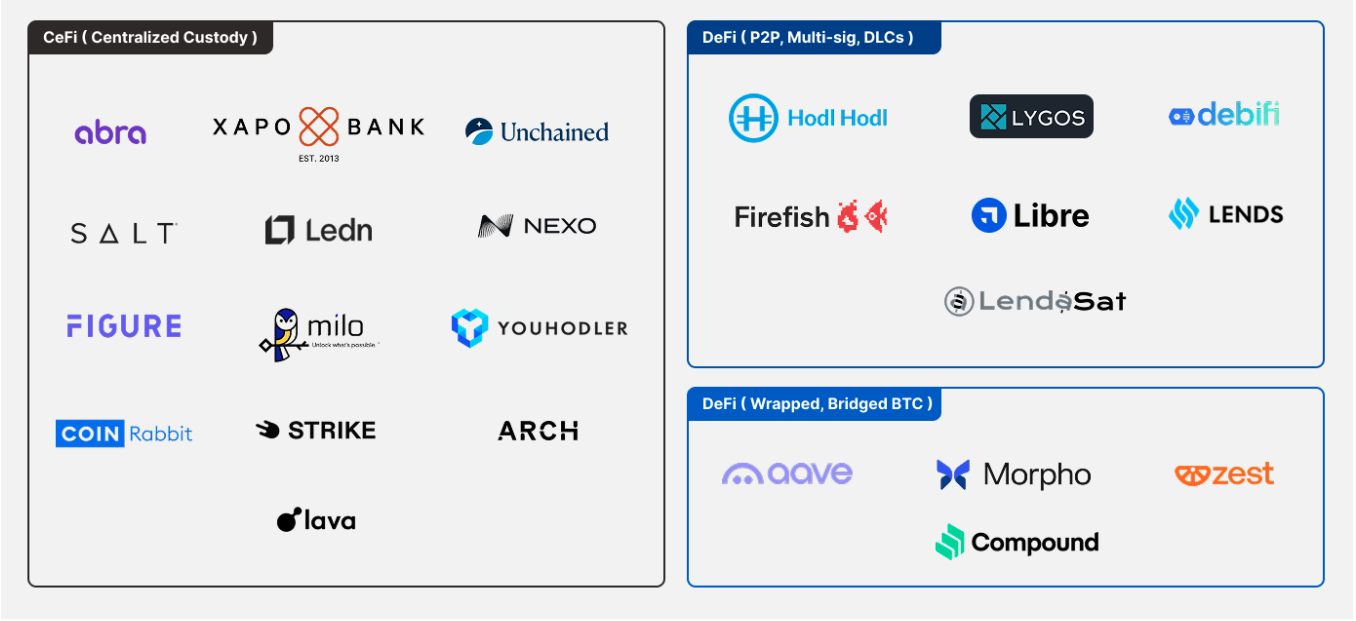
The visual below highlights key players across each category
Key Insights from the Market Analysis
- Lending product emergence follows market cycles: New players and usage spikes occur every bull market, signaling genuine demand.
- CeFi still dominates: With unclear regulation, custodians like BitGo and Anchorage have become infrastructure backbones, contributing to CeFi’s continued hold.
- Transparency remains lacking: While a few platforms have started offering proof-of-reserve reports, most shy away from disclosing custody details - despite managing digital, on-chain assets.
- Borrowing costs are high: CeFi-led models come with higher rates, predatory liquidations, and opaque loan terms
- Access is limited: Many platforms cater to HNWIs or institutions, sidelining everyday Bitcoiners (less than ten BTC) who face higher borrowing costs and fewer options.
- Decentralized platforms are gaining ground: A wave of new entrants is adopting trust-minimized infrastructure and on-chain verification. While still early, this category is poised to disrupt the current centralized players.
What’s Missing in Bitcoin Lending?
We’ve created a new visual map that charts Bitcoin-backed lending platforms across two axes:
- X-Axis: Market Focus from HNWIs to Grassroots Bitcoiners
- Y-Axis: Custody Model from Full Custody to Self-Custody
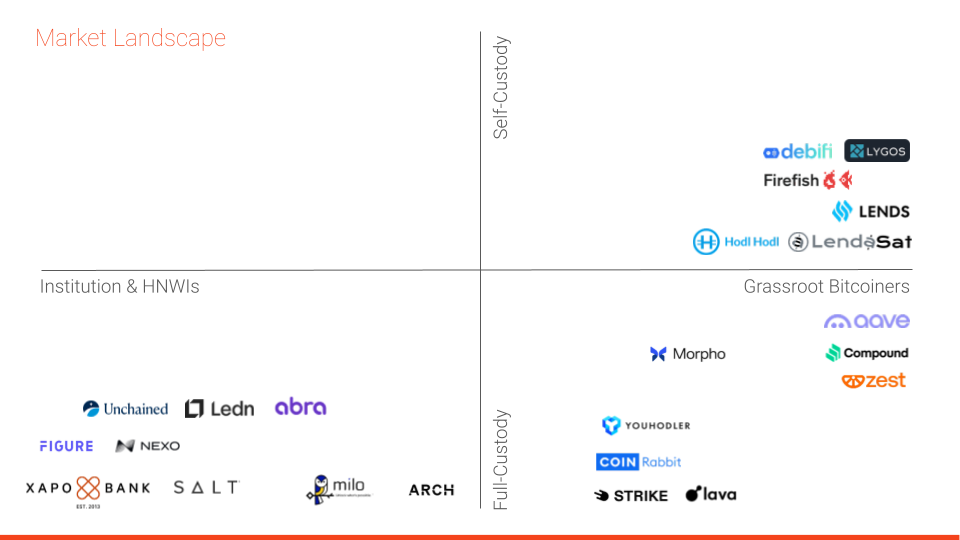
This view helps understand how players position themselves in terms of accessibility and transparency.
We also introduce a new category
Surge doesn’t just fit into the existing categories - it reimagines the model entirely:
- Non-custodied BTC in verifiable, non-rehypothecated dVaults
- Open lending markets for rate discovery and fair access
- Programmable loan terms enforced on-chain
It’s not a CeFi platform. It’s not DeFi built elsewhere. It’s a Bitcoin-native Credit Market, a fundamentally new design